
 Give Feedback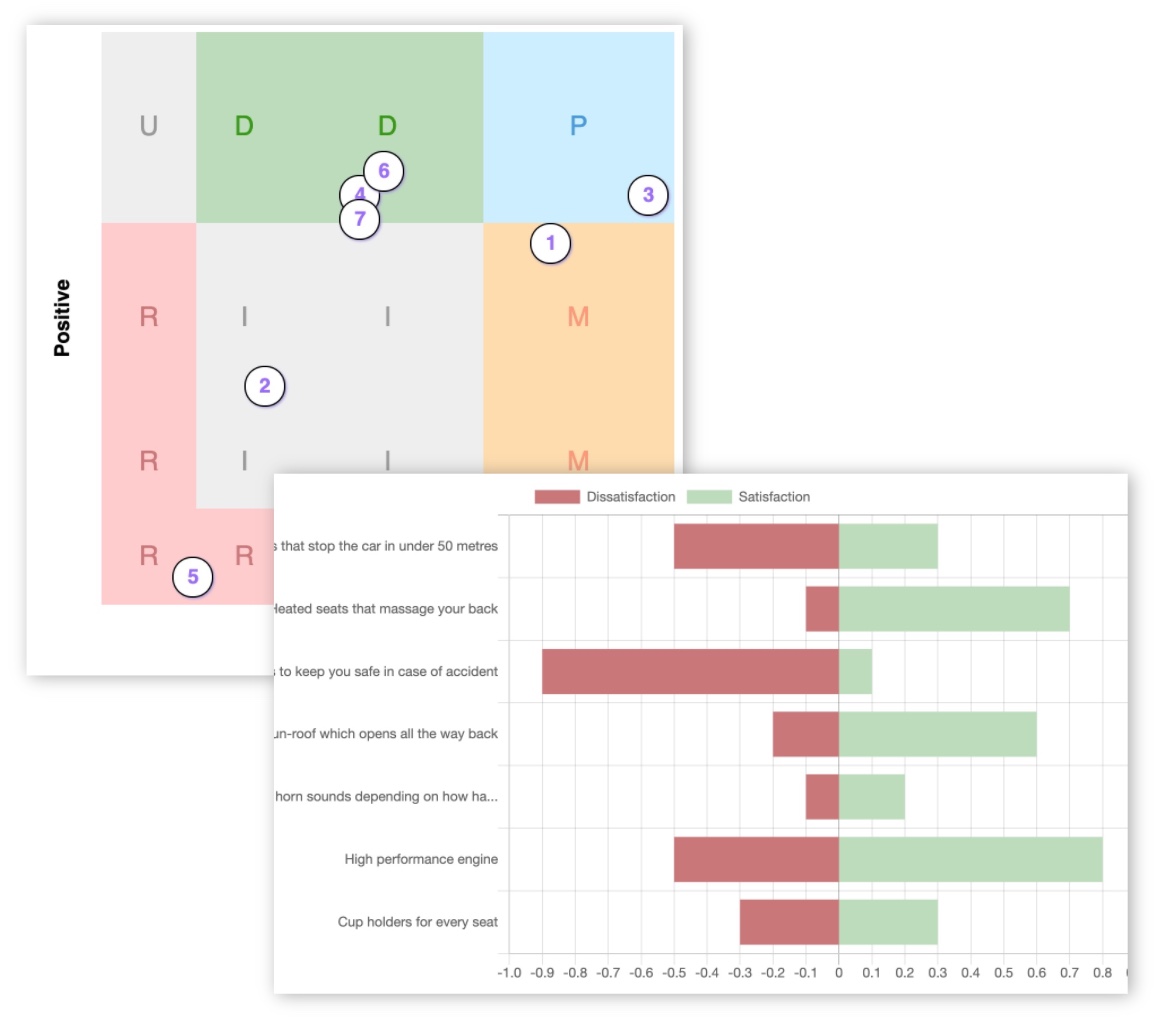
Performance Features in the Kano Model: What They Are, Why They Matter, and How to Design Them
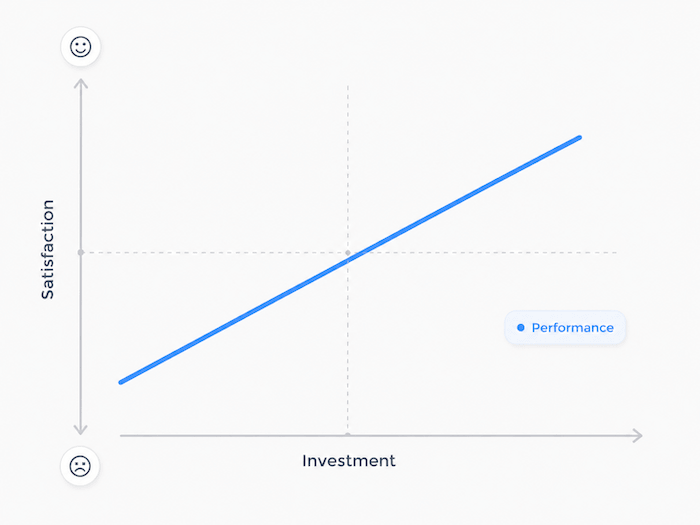
Performance features are where better usually means better. They are often the clearest path to higher satisfaction and stronger product-market fit.
Not all product features affect customer satisfaction in the same way.
Some features are expected. If they are missing, customers get annoyed, but if they are present, nobody celebrates. Some features are surprising and delightful. Others barely move the needle.
Performance features sit in the practical middle. They are the features where better usually means better: faster delivery, longer battery life, more accurate results, easier setup, lower cost, less waiting.
That is why Performance features are such an important part of the Kano Model. They are often the features customers can describe most clearly, compare most directly, and use when deciding which product is worth choosing.
A quick recap of the Kano Model
The Kano Model groups product features by how they affect satisfaction. The key question is not only "Do customers want this?" but "What kind of want is this?"
- Must-be features: basic expectations. If missing, satisfaction drops quickly.
- Performance features: the focus of this article. Satisfaction rises as the feature improves.
- Delighters: unexpected features that can create strong positive reactions.
- Indifferent features: things customers do not care much about.
- Reverse features: things that make some customers less satisfied.
Performance features matter because they sit at the centre of buying decisions. They are visible, comparable, and closely tied to perceived value.
What are Performance features?
Performance features are also called one-dimensional features, linear satisfiers, or more-is-better attributes. Different names, same idea: better performance usually leads to higher satisfaction; weaker performance usually leads to lower satisfaction.
It is not perfectly mathematical, because customers are not spreadsheets. But the direction is usually clear. If customers value it, improving it tends to improve satisfaction.
Common patterns include:
- Faster is better.
- Easier is better.
- More reliable is better.
- More accurate is better.
- Longer lasting is better.
The word "Performance" can sound technical, but the category is broader than speed and uptime. In a phone, battery life can be Performance. In ecommerce, delivery speed can be Performance. In healthcare, diagnostic accuracy can be Performance. In SaaS, onboarding speed, reporting quality, integrations, and admin flexibility can all be Performance.
The common thread is comparability. Customers can evaluate the feature on a scale and say, "This is better than that." That makes Performance features easier to measure and easier to connect to customer outcomes.
Why Performance features matter psychologically
Performance features matter because customers use them to compare options.
When choosing between two products, people naturally ask: Which one is faster? Cheaper? Easier to set up? More reliable? More accurate? These comparisons are simple, but powerful.
Performance features also shape perceived value. Customers are constantly trading money, time, effort, risk, and trust. When a product performs well on what matters most, that trade-off feels fair.
A customer may think, "This costs more, but saves me hours," or "This tool is simple, but the core workflow is excellent." That feeling of fairness is central to satisfaction.
Performance improvements also reduce friction: faster workflows reduce impatience, better search reduces cognitive load, better accuracy reduces rework, and faster support responses reduce uncertainty.
Over time, this builds trust. A product that consistently performs in key moments starts to feel dependable, and customers move from testing it to relying on it.
How Performance features affect CSAT
Performance features usually have a direct effect on CSAT because customers consciously evaluate them.
If a dashboard becomes faster and easier, users feel it immediately. If check-in becomes faster at a hotel, satisfaction rises. If support replies more quickly, customers feel less ignored.
Weak Performance features are risky because customers can usually name the issue:
- "It is too slow."
- "It costs too much."
- "The results are not accurate enough."
- "Setup takes too long."
That is useful because these complaints are actionable. Teams can measure the underlying attribute, improve it, and test the impact.
One nuance matters: diminishing returns. The jump from eight seconds to two seconds can transform usability. The jump from one second to 0.8 seconds may not be noticeable for most users. So the goal is not endless optimisation. The goal is improving by a significant margin.
Examples of Performance features in software
In SaaS, Performance features might include dashboard loading speed, reporting quality, useful integrations, onboarding time, uptime, workflow completion time, permissions flexibility, or alert accuracy.
In ecommerce, common examples include search relevance, checkout speed, delivery speed, return convenience, stock accuracy, filtering quality, and pricing competitiveness.
For mobile apps, think launch speed, battery usage, navigation ease, and notification relevance.
AI products have their own Performance dimensions: output accuracy, response speed, context retention, editing control, cost per useful output, and workflow fit. "Useful output" is key. A flashy demo can impress once, but customers usually care about getting good results with less effort.
Examples in hardware, services, and physical products
Performance features are not just for software. They show up everywhere.
In consumer electronics, customers compare battery life, charging speed, camera quality, durability, and weight. In cars, they compare fuel efficiency, safety, comfort, range, and reliability.
In home appliances, they compare energy use, noise, capacity, cleaning quality, and lifespan. In furniture, comfort and durability often matter more than extra settings or visual flair.
Services are full of Performance features too: waiting time, response speed, accuracy, availability, convenience, and price clarity. Clinics, airlines, universities, consultancies, and delivery services are all judged on these attributes.
This is a core strength of Kano: it works anywhere customers have expectations, compare options, and decide what feels worth it.
Category drift: Performance features change over time
Kano categories are not fixed. Expectations move over time as customers get used to your product and competitors evolve.
A feature can start as a Delighter, become a Performance feature once customers compare it directly, and eventually become Must-be once all competitors have reached the same maximum level of performance for that feature.
Smartphone cameras are a classic example. So is fast postal delivery of packages. AI writing assistance is currently moving through the same pattern in many categories.
When a Performance feature becomes Must-be, doing it well may no longer create extra satisfaction, but doing it poorly creates frustration fast. Fast page load, secure checkout, mobile-friendly design, and reasonable battery life have drifted in this direction.
The opposite can happen too. Some attributes become less important over time as technology or behaviour changes. That is why teams should retest assumptions regularly. Yesterday's differentiator can become today's baseline.
How to design strong Performance features
Start by identifying what customers actively compare. You can find this in interviews, sales calls, support tickets, reviews, churn reasons, competitor comparisons, and Kano surveys.
Listen for language like "takes too long," "not accurate enough," "hard to control," or "not worth the price." Those are signals of Performance dimensions.
Next, make the target measurable and outcome-focused. "Improve onboarding" is vague. "Cut setup time from twenty minutes to five" is specific. "Improve reporting" is vague. "Let users produce a weekly report without exporting data" is better.
Always connect the metric to customer impact. More integrations matter only if they remove manual work. Faster pages matter most where slowness blocks progress. Better accuracy matters most where mistakes are costly.
Watch for diminishing returns, and avoid adding complexity in the name of "more". Extra settings, widgets, and options can reduce clarity for many users.
Segmentation is essential. Enterprise buyers may prioritise permissions, uptime, and auditability. Smaller teams may prioritise simplicity and cost. One feature can be Performance for one segment and Indifferent or Reverse for another.
Kano surveys help validate this. For Performance features, look for a consistent pattern: customers are more satisfied when the feature is strong, and less satisfied when it is weak or absent.
Common mistakes with Performance features
A common mistake is assuming every requested feature is Performance. Some requests are actually Must-be, some only matter to a niche segment, and some create little real satisfaction after release.
Another mistake is over-optimising internal metrics customers never perceive. If the change does not improve customer outcome, confidence, or willingness to choose the product, it is probably not high-value Performance work.
A third mistake is competing only on Performance. Performance matters, but it is often copyable. Strong products still need dependable Must-be foundations and, where appropriate, a few thoughtful Delighters.
Finally, many teams ignore category drift and keep messaging a feature as differentiating long after the market treats it as expected. That leads to weak positioning and underperforming marketing.
Final thoughts
Performance features are where better execution usually leads to higher satisfaction. They are visible, measurable, and easy for customers to compare, which makes them central to value perception and buying decisions.
They exist everywhere: software, hardware, services, logistics, education, healthcare, and physical goods.
The most useful question is not just "What should we build next?" It is "Which qualities do customers actively compare, and how much better do we need to be to matter?"
That question improves prioritisation, keeps strategy grounded in real customer trade-offs, and helps teams invest in improvements people actually notice.
Performance features may not always feel flashy, but they are often where products win or lose. Get them right, and customers feel your product is worth their time, money, and trust.
Want a quick refresher on all five categories? See the Kano matrix which shows how the answers map together.
Want to prioritise your roadmap with real customer signals?
Create your first Kano survey now