
 Give Feedback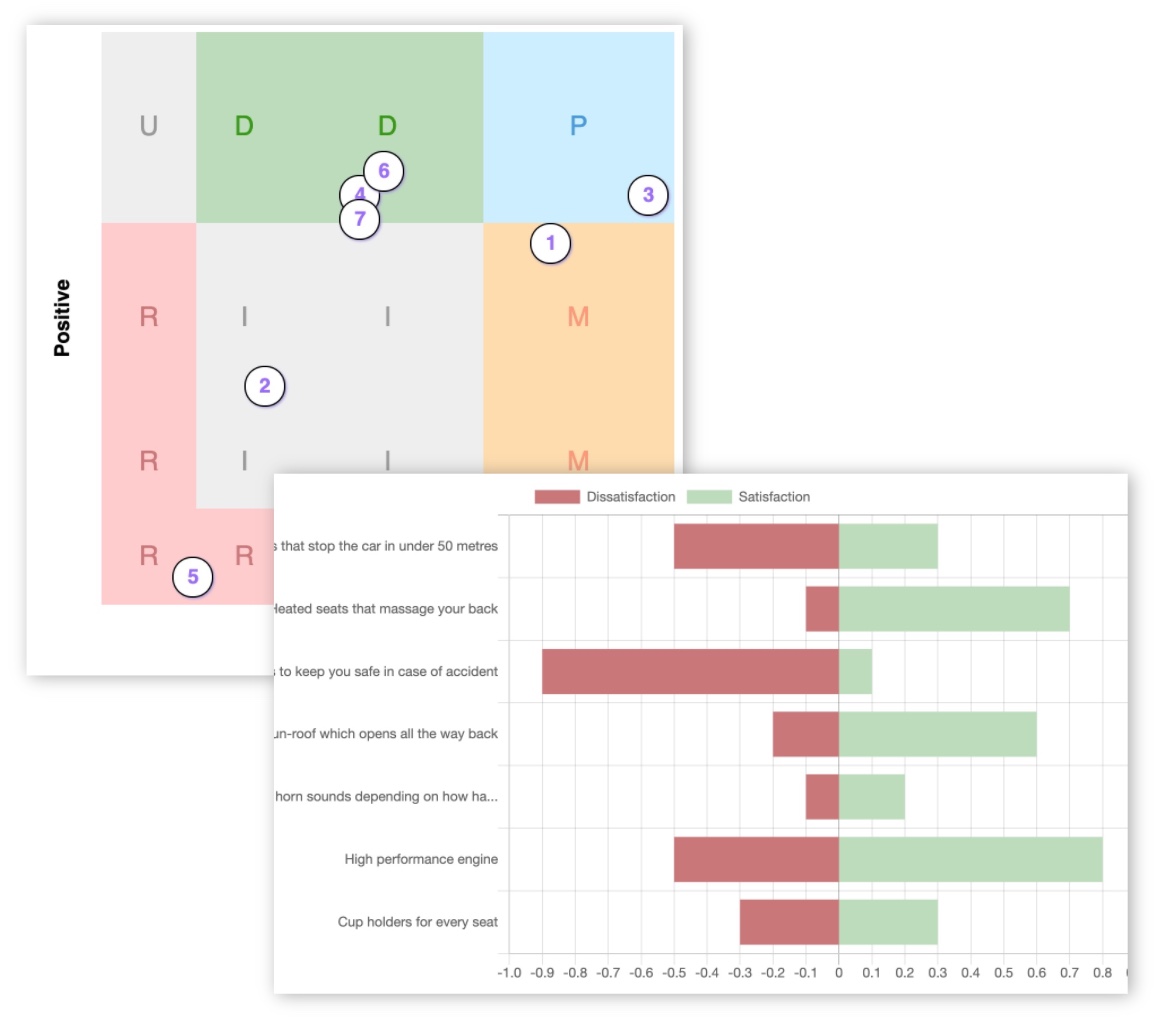
Delighters in the Kano Model: How Unexpected Features Create Customer Satisfaction
Delighters are the features people rarely ask for, but really appreciate once they see them in action.
Some product features barely register until customers actually use them. They rarely come up in sales calls or feature request lists, but when they appear, they create surprise, a genuine emotional lift, and strong word of mouth.
In the Kano Model, these are Delighters (also called Attractive Quality, Exciters, or Wow Features). They are not just "nice extras". A good Delighter creates an outsized satisfaction response because it delivers value people were not expecting.
In mature markets where products share similar baseline functionality, Delighters can be a meaningful differentiator. They make a product feel thoughtful, memorable, and worth talking about.
Quick recap: the 5 Kano Model categories
The Kano Model groups features by how they influence customer satisfaction:
- Must-have features: basic expectations. If missing, satisfaction drops fast.
- Performance features: "more is better" features. Better performance means higher satisfaction.
- Delighters: unexpected features that create strong satisfaction when present.
- Indifferent features: features customers largely do not care about.
- Reverse features: features some customers actively dislike.
What are Delighters?
Delighters are features or experiences customers do not expect, but respond to very positively when they encounter them.
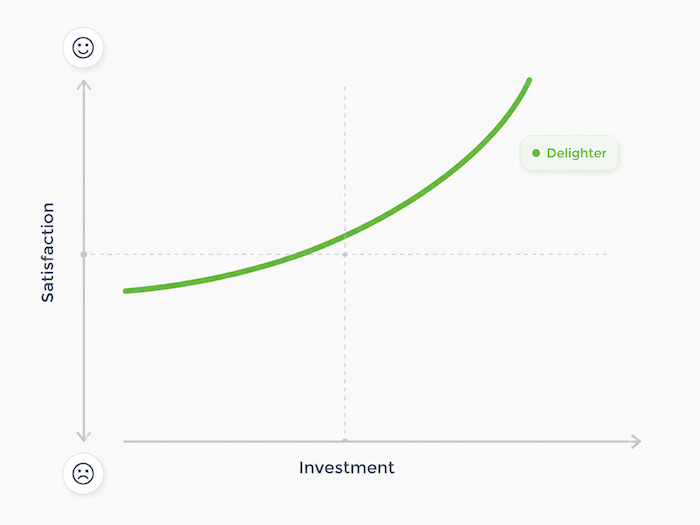
They have an asymmetric effect: if absent, people are often neutral; if present, satisfaction can jump. That makes them different from Must-have features (which prevent dissatisfaction) and Performance features (which customers expect and compare directly).
Delighters are often more emotional or context-led. They might be smart defaults, helpful automation, proactive support, or thoughtful details that remove friction. They do not need to be big or expensive to matter.
Why Delighters work
Delighters work because satisfaction is tightly tied to expectation. A product does not delight people just by being good. It delights when the experience beats what they expected.
The pattern is simple:
- Poor delivery of an expected feature creates dissatisfaction.
- Good delivery of an expected feature creates satisfaction.
- Good delivery of unexpected value creates delight.
That gap between expected value and received value is where Delighters get their power. People remember moments where something felt easier, faster, or more thoughtful than expected, and those moments often shape CSAT.
For example, when a tool turns messy meeting notes into structured tasks automatically, it does more than save time. It removes effort exactly when users expected manual work. Small moments like that can have a bigger impact than their roadmap size suggests.
Why customers often do not ask for Delighters
Customers are usually good at describing what they already understand: current pain, current workarounds, and expected improvements. They are much less likely to ask for a novel interaction or a convenience they have never seen.
That is why Delighters rarely come from counting feature requests alone. They usually come from observation, interviews, support patterns, journey mapping, prototypes, and close friction analysis.
Users may not ask for automatic meeting summaries, but they will complain about lost context and follow-up effort. The Delighter is solving that underlying problem in a way they did not see coming.
Delighters and emotional design
Delighters often work on several levels at once: practical ("this saved me time"), cognitive ("this understands me"), emotional ("that felt good"), and social ("I want to tell someone").
That is why they are powerful. They do not just complete a task, they change how the experience feels. A tax app that explains confusing fields in plain English, a duplicate-payment warning in a banking app, or a car that preconditions temperature are all good examples.
Why Delighters matter in a well-rounded product
A product cannot survive on Delighters alone. Strong products need Must-have features to prevent dissatisfaction, Performance features to compete on clear value, and Delighters to create differentiation and emotional attachment.
Delighters help move customers from "it works" to "I love it," but they are not a substitute for broken basics. A clever extra will not rescue unreliable performance or a confusing core workflow.
Delighters work best when the foundation is already solid.
Examples of Delighter features
Delighters can be digital, physical, service-based, or emotional.
In SaaS, they might be anomaly highlights, adaptive onboarding, or "magic import" from messy spreadsheets. In productivity tools, they might be contextual shortcuts, smart date parsing, or natural-language task creation.
In ecommerce, useful recommendations, accurate delivery estimates, or relevant samples can reduce uncertainty. In banking/fintech, clear fee explanations, overdraft warnings, and spending insights create reassurance. In healthcare/wellness, supportive reminders and plain-language guidance can build trust.
Hardware has Delighters too: earbuds that pause when removed, laptops that wake instantly, walk-away car locking, or packaging that is genuinely easy to open. Small details often make products feel polished.
Category drift: how Delighters change over time
Kano categories are not permanent. As markets mature, expectations change. A feature that delights users today may be expected tomorrow. This movement is called category drift.
A common path looks like this:
- The feature is unknown or unimagined.
- It becomes a Delighter.
- Competitors copy it, so it becomes a Performance feature.
- Customers start expecting it, so it becomes a Must-have feature.
Smartphone cameras, free shipping, autocomplete, and real-time collaboration all followed this path: first surprising, then differentiating, then expected.
Category drift is why teams cannot rely on the same Delighters forever. What once felt special can become the price of entry.
Where Delighters come from
Before something becomes a Delighter, it often appears first as hidden friction: repeated manual work, normalised frustration, or a capability users patch together with workarounds.
Users may not ask for automatic meeting summaries, but they may repeatedly copy tasks around and worry about missing decisions. The Delighter is the unexpected removal of that effort.
Not every Delighter stays delightful. Some drift to Performance or Must-have. Some become Indifferent, and some become Reverse if they get intrusive. Notifications are a classic example.
How to identify potential Delighters
The best Delighters usually come from close observation of user behaviour.
Look for hesitation, repeated work, tool-switching, manual copy/paste, homemade templates, or recurring support questions. These are signs users are carrying effort the product could remove.
Listen beyond the literal request. "Better export" may mean "clearer report." "More configuration" may mean "better defaults." "More reminders" may mean "confidence nothing will be missed."
Useful questions:
- What is the user really trying to achieve?
- What are they worried about?
- What effort have they accepted as normal?
- What would make them feel confident?
- What happens immediately before and after this task?
Studying adjacent industries helps too. What is normal in one category may still be surprising in another.
Segmentation matters: a Delighter for one group may be Indifferent or Reverse for another. The real question is not only "Is this a Delighter?" but "For whom?"
Tips for designing Delighter features
Start with a solid baseline. Do not prioritise Delighters while Must-have features are broken. Reliability, usability, trust, speed, and core workflow come first.
Then design around moments, not just feature lists. Delighters are strongest at high-emotion points: first setup, first success, error recovery, handoffs, and difficult-task completion.
The best Delighters remove effort unexpectedly, reduce cognitive load, prevent mistakes, and make users feel understood. Often they are lightweight improvements, not huge roadmap items.
Avoid gimmicks. Confetti, noisy notifications, and flashy AI without clear value are decoration, not Delighters. A Delighter has to create real value.
Be careful with surprise in serious contexts
Surprise is not always appropriate.
In banking, healthcare, insurance, aviation, legal software, and enterprise security, Delighters should feel reassuring rather than playful.
In serious contexts, the best Delighters are clear, helpful, accurate, and respectful.
Testing Delighters with Kano surveys
Kano surveys identify Delighters using paired questions: one asks how users feel if a feature is present, and the other asks how they feel if it is absent.
Delighters are usually features people like having, but do not strongly miss when absent.
Because users may struggle to imagine new ideas, test with prototypes, demos, screenshots, or concrete scenarios. Also ask directly what felt unexpectedly helpful and what users would miss if removed.
Monitor category drift
Because Delighters become expected over time, revisit Kano research regularly.
Watch for drift signals: competitors adding the same capability, customers asking for it directly, sales objections mentioning its absence, or support tickets assuming it should exist.
Once users expect it, manage it as Performance or Must-have, not as a Delighter.
Conclusion
Delighters are unexpected product qualities that create an outsized satisfaction response.
They help products stand out and create positive stories, but they are not a substitute for solid fundamentals.
Must-have features prevent dissatisfaction. Performance features create measurable value. Delighters add surprise, preference, and emotional attachment.
The best Delighters come from deep user understanding, not random novelty. Over time, successful Delighters become expected, so teams need to keep researching and finding new sources of unexpected value.
Delighters in one sentence: Delighters are unexpected product qualities customers may not ask for, but really value once they experience them.
Key takeaway: A Delighter is not just a fun extra. It is a thoughtfully designed moment of unexpected value.
Want a quick refresher on all five categories? See the Kano graph with the different combinations.
Ready to turn customer feedback into feature priorities?
Create your first Kano survey now