Give Feedback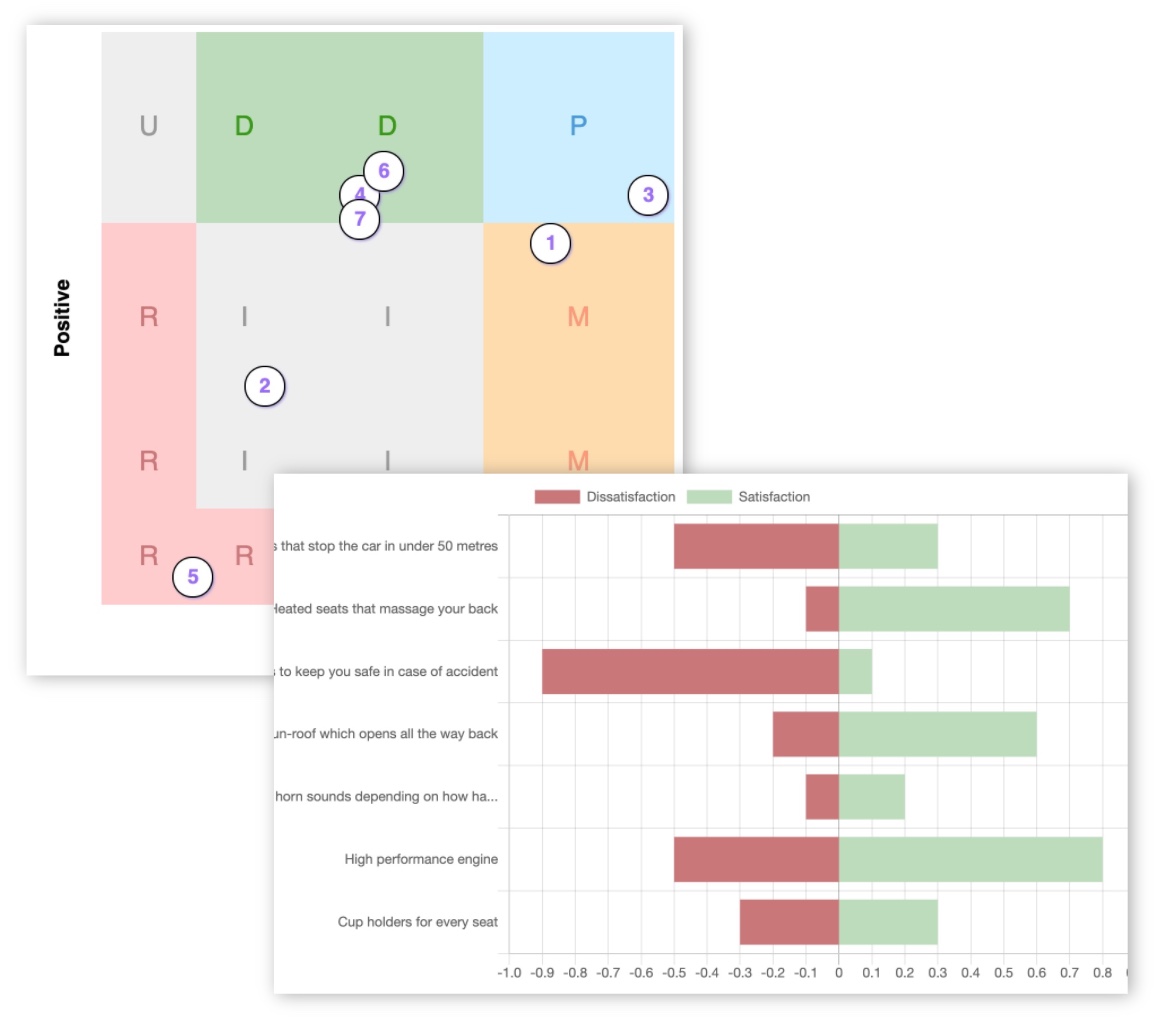
KanoSurveys vs Conjointly: which Kano Model survey tool should you use?


Choose the faster Kano-only workflow or the broader research suite, depending on what your team actually needs.
Kano Model surveys are powerful, but they are awkward to run by hand. Every feature needs a functional and dysfunctional question pair, and the responses still need to be categorised into Must-have, Performance, Attractive, Indifferent, Reverse, or Questionable. The real value comes after that: comparing features, segmenting responses, and turning the output into roadmap decisions.
Short answer: choose KanoSurveys if Kano is the main job. Choose Conjointly if Kano is one method inside a broader research programme.
That is the real decision here. KanoSurveys is purpose-built for Kano surveys. Conjointly is a broader research platform that includes Kano alongside other advanced methods like conjoint analysis, MaxDiff, and pricing research.
Quick comparison
| Tool | Best for | Strength | Trade-off |
|---|---|---|---|
| KanoSurveys | Focused Kano surveys and roadmap prioritisation | Fast setup, automatic analysis, practical prioritisation | Narrower research scope |
| Conjointly | Multi-method research and advanced studies | Broad method library, panels, reporting, support | Heavier and more expensive if you only need Kano |
- ✓ Built around the Kano question flow
- ✓ Automatic analysis without spreadsheets
- ✓ Prioritisation is part of the product
- ✓ Easier for product teams and founders
- ✓ Better for mixed-method research
- ✓ Includes respondent sourcing and panels
- ✓ Stronger reporting and exports
- ✓ Useful when Kano is only one input
What KanoSurveys does best
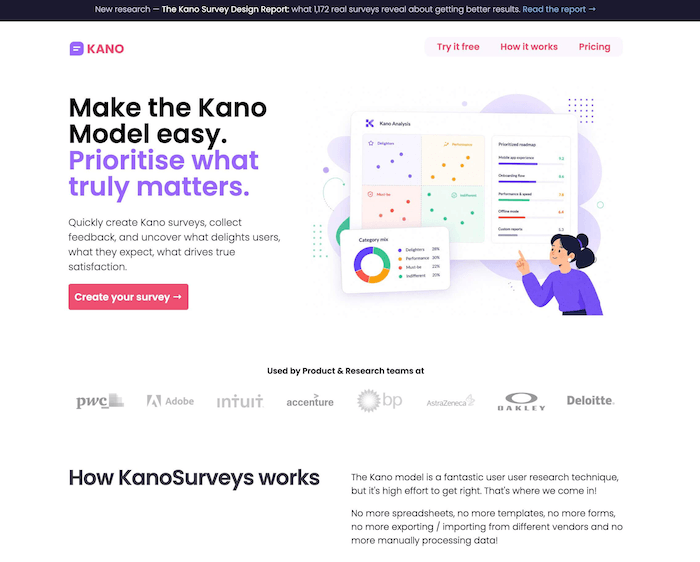
KanoSurveys is the more direct tool if your job is to create, distribute, analyse, and prioritise a Kano survey quickly. It removes the spreadsheet step, supports hosted survey links, and gives you real-time Kano analysis plus feature prioritisation in one workflow.
Why it fits Kano work
- Built specifically for Kano surveys
- Fast survey setup and sharing
- Automatic category analysis
- Prioritisation baked into the workflow
Where it is narrower
- Not a broad market research suite
- Not designed for many unrelated study types
- No need to expect enterprise research tooling
For product teams, founders, and UX researchers, that narrow focus is a feature. If the goal is to decide what to build next, the shortest path usually wins.
What Conjointly does best
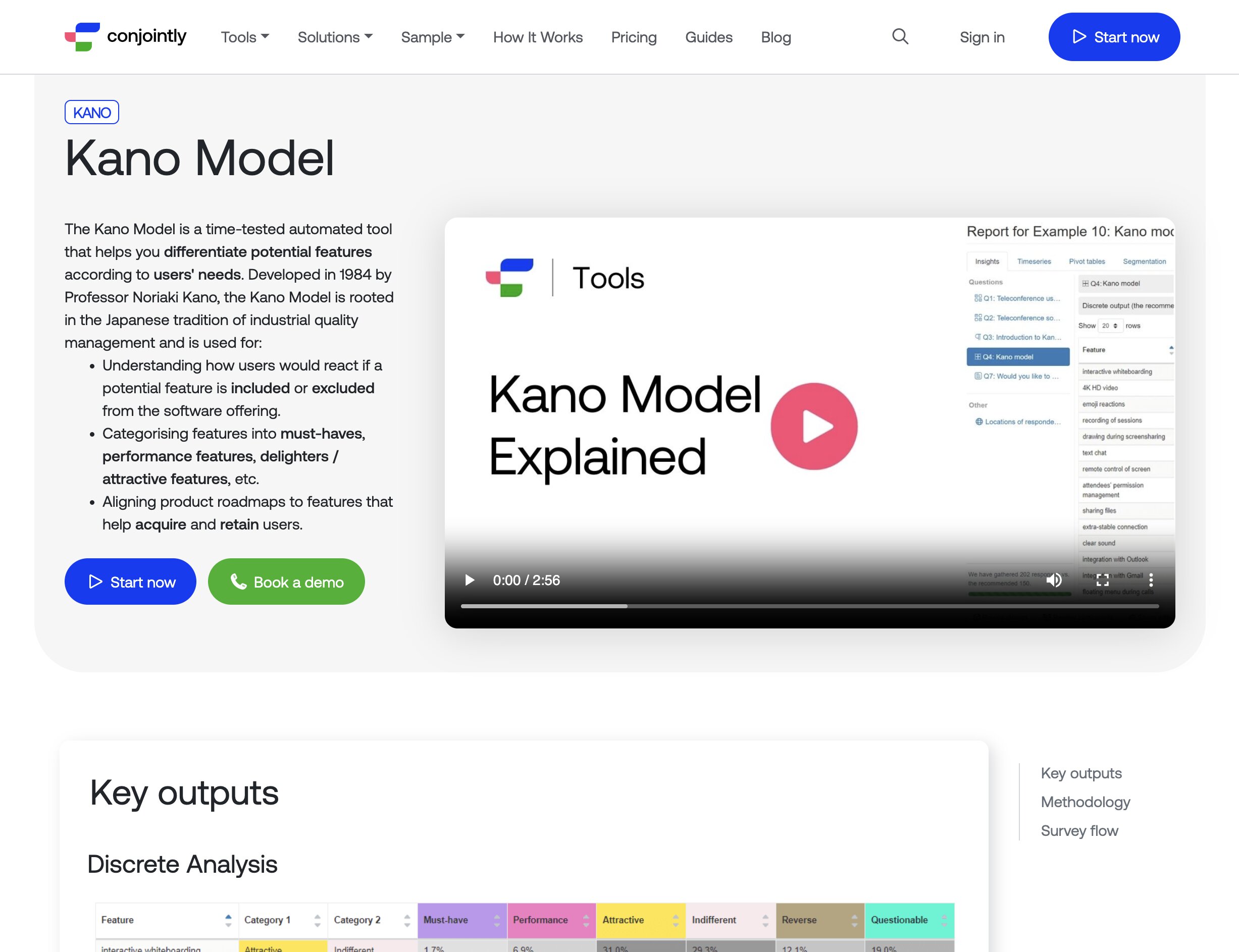
Conjointly is stronger when Kano is only one part of a larger research programme. It supports Kano Model studies, but it also goes much further with conjoint analysis, MaxDiff, pricing research, concept testing, feature placement, respondent sourcing, and formal reporting.
| Research need | KanoSurveys | Conjointly |
|---|---|---|
| Kano survey creation | ✓ Strong | ✓ Good |
| Roadmap prioritisation | ✓ Strong | ✓ Good |
| Conjoint / MaxDiff / pricing work | × Not the focus | ✓ Strong |
| Respondent sourcing / panels | × Limited | ✓ Strong |
| Formal reporting and exports | ✓ Practical | ✓ Strong |
Ease of use
If you want the simplest path from feature list to analysed results, KanoSurveys is easier because it is narrower. You do not need to design the Kano flow from scratch or adapt a generic survey builder.
- ✓ KanoSurveys: less setup, less cognitive load, less room for error
- ✓ Conjointly: still usable, but its breadth adds configuration overhead
In practice, narrowness is usually an advantage for Kano-only work. Breadth is helpful when you need flexibility, but it can slow down a simple feature-prioritisation study.
Analysis and prioritisation
This is the biggest practical difference. KanoSurveys is built to turn survey answers into actionable prioritisation, so it is better for roadmap decisions. Conjointly can analyse Kano data well, but its real strength is combining Kano with other methods when the question is bigger than satisfaction alone.
Best when you need: feature ranking, satisfaction impact, and a practical next-step decision.
If your question is only “which features satisfy customers?”, either tool can help. If your question becomes “which bundle, package, or feature set should we take to market?”, Conjointly starts to make more sense.
Pricing and panels
| Pricing factor | KanoSurveys | Conjointly |
|---|---|---|
| Entry cost | Lower and Kano-specific | Free basic tier, but advanced methods cost more |
| Advanced research methods | Not the main focus | Included on paid plans |
| Panels / sample sourcing | Not primary positioning | Available, but extra cost may apply |
KanoSurveys is positioned as the more affordable, Kano-specific option. Conjointly’s free plan is useful, but advanced methods sit on paid annual licences, and panel responses cost extra. That price is justified when you need multiple research methods or respondent sourcing, but it is hard to justify for Kano-only work.
- ✓ Kano is the main use case
- ✓ You want speed over breadth
- ✓ You already have users or customers to survey
- ✓ You want prioritisation, not spreadsheet work
- ✓ Kano is part of a bigger research stack
- ✓ You need conjoint, MaxDiff, or pricing research
- ✓ You need panels or respondent sourcing
- ✓ You need more formal reporting
Verdict
Choose KanoSurveys if you want the quickest route to a well-run Kano survey, automatic analysis, and prioritised product insight.
Choose Conjointly if Kano sits inside a broader research programme that also needs conjoint analysis, MaxDiff, pricing work, panels, and enterprise-style reporting.